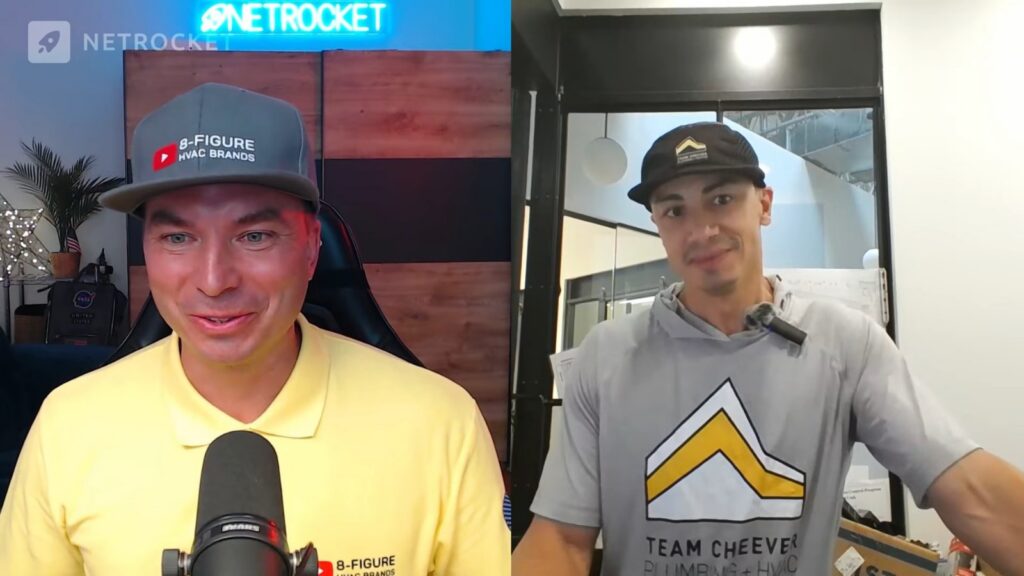
In this episode of the 8-Figure HVAC Brands Podcast, Netrocket founder Daniel Dramshev talks with Jonathan Cheever, owner of Team Cheever Plumbing + HVAC in Park City, Utah. Jonathan is a second-generation master plumber and a former member of the U.S. Snowboard Team who competed in the Olympics. He and his wife started Team Cheever in January 2024, and in 2025, the company did $3 million with four technicians. He shares where they spent marketing money and lost it, what brought the best return, how his team sells without pressure, and how they get through the slow season in a ski town.
About the guest
| Name | Jonathan Cheever |
| Company | Team Cheever Plumbing + HVAC |
| Location | Park City, Utah |
| Founded | January 2024 |
| Revenue | $1.2 million in 2024, $3 million in 2025 |
| Services | Plumbing, HVAC, hydronics, and fire suppression |
From the U.S. Snowboard Team back to plumbing
Jonathan’s dad started a plumbing business outside Boston in the 1970s, and his dad and brother still run it. In high school, Jonathan went to night school to get his plumbing license and earned his journeyman license at 18. When he started studying mechanical engineering, a professor said engineers could make $60,000 a year after graduation. Jonathan was already making more than that as a journeyman plumber.
In 2004, he moved to Park City to chase his snowboarding dream. He made the U.S. Snowboard Team in 2005 and competed in the Olympics, 10 X Games, and about 100 World Cups. His last World Cup was in March 2021. Along the way, he also worked for plumbing contractors in Utah.
After snowboarding, Jonathan and his wife did small renovation projects as general contractors. When that work dried up in 2022 and 2023, they hired a coach and decided to go full-time into plumbing home services. Team Cheever launched in January 2024. Its first plumber came from a drain cleaning company that Jonathan called for help on his very first job, and his wife answered the phones and handled dispatch.
Growth so far
In 2024, Team Cheever did $1.2 million and finished the year with four technicians, but it operated at a loss. In 2025, the company did $3 million with four technicians, plus Jonathan in the field part of the time. By the end of July 2026, the company had 13 vans, and its ninth technician was about to start. The goal is to have 16 technicians by the end of the year. Jonathan says linear growth would mean a little over $4 million this year, but he’s aiming for $6 million.
A friend of his did $7 million in his first year. In Jonathan’s view, owners with that kind of start usually spent decades in the industry and already had technicians, customers, and comfort advisors ready to follow them. Team Cheever had to build its network from scratch, so networking and community outreach are a big part of its marketing.
Serving a high-end ski town
Park City is a strong market for home services. The average single-family home there is worth about $4 million, and some homes are 20,000 square feet with nine air handlers and three boilers. But the population drops from 35,000 people in winter to 8,000 in spring and summer, so the business is very seasonal.
Year to date, Team Cheever’s average ticket across plumbing and HVAC is $3,030. Its top technician averages $6,000.
“We dispatch for dollars.“
To even out the seasons, the company opened a second office a few months ago near Salt Lake City, mainly for Google. Most of its technicians live in that area. It now gets about five jobs a week there, while 95% of revenue still comes from Park City. Opening a second location is one way to show up in a new market on Google Maps. See how Netrocket handles Google Maps SEO.
Revenue mix: plumbing, HVAC, hydronics, and fire suppression
In 2025, HVAC brought in a little more than an eighth of revenue, and fire suppression brought in about 1%. In 2026, Team Cheever has three HVAC technicians, one leading sales and two installing. So far this year, HVAC accounts for about a third of revenue, hydronics for about a third, and fire suppression for about 10%. The rest is plumbing.
Fire suppression started with mechanical rooms. Jonathan is certified to test backflow preventers, and every fire riser has one. When his team sees a leaking riser, they can rebuild it, and sometimes that’s a $12,000 job.
Where the marketing money went
“Marketing makes the world go round.“
Team Cheever competes with companies that do nine and ten figures a year. Jonathan’s approach is to be the local, family-owned business, spend money to acquire customers, and learn from mistakes. A few of those mistakes were expensive:
- A magazine ad: $36,000 spent to acquire one customer who did $400 in revenue
- Google during a slow February: he raised the daily budget to $10,000, spent $22,000 in seven days, and got one pressure-reducing valve install worth about $900
He also says that in Park City, Google can bill Team Cheever about $600 just to receive a single call. If you want your LSA budget to bring in profitable jobs, see how Netrocket handles LSA management for HVAC contractors.
In 2025, Team Cheever spent about $350,000 on customer acquisition. That included:
- Content creation: $3,500 a month, or about $42,000 a year
- SEO, website, and analytics: $3,000 a month
- Social media management: $2,500 a month
- Google, local digital publications, and monthly networking dinners
The best return: dinners with community leaders
Every month, Jonathan’s wife hosts a dinner at a restaurant in Park City for community leaders and entrepreneurs, and Team Cheever pays for it. Last year, the dinners cost about $20,000.
“We got $180,000 in revenue just from taking people out to dinner.“
In 2025, 70% of Team Cheever’s revenue came from existing customers, 15% came from word-of-mouth referrals, and 15% came from everything else, including Nextdoor, Facebook, Instagram, LSA, Google, and Yelp. If you run a plumbing company and want more of your growth to come from the right channels, see how Netrocket approaches digital marketing for plumbers.
Selling without pressure
Team Cheever doesn’t have comfort advisors. Technicians sell and install, and the comp plan avoids the production-only model Jonathan sees at many private equity companies. His approach is to be straight with the homeowner and offer options.
His example is a flapper valve. For the company to make $50 or $60 on it, it has to charge $400 to $500, and Jonathan admits that sounds crazy for a $20 or $30 part. But Park City water is very hard, so a technician can test the water, check the valves in the mechanical room and under the sinks, and offer options. If the homeowner replaces a dozen stop valves, the flapper valve is free, and sometimes a water softener comes out of it too.
His top plumber is a former attorney who went back to the trade. Jonathan says he sells and installs over $100,000 a month because he knows how to talk to people.
“Be a human. That’s more important than anything else.“
Winning a job at more than double the price
There are shops in town that are much cheaper than Team Cheever. In one case, the company quoted about $40,000 to replace a boiler and mechanical room system. Another shop quoted $17,000. When the homeowner asked why, Jonathan offered to compare the bids. The other bid was a carbon-paper receipt with three lines on it. Team Cheever uses AI to help technicians build clear presentations that list everything in a digestible way. The homeowner saw that it was a different product and went with Team Cheever.
Jonathan also chose to put his own name on the trucks. A coach told him not to name the company after himself, but in a small town where he snowboards with customers and sees them at the grocery store, he believes the personal brand builds trust. Team Cheever has a 4.9-star rating on Google.
“I want my name on my truck.“
How they handle the slow season
In 2025, the bottom fell out in March and April, and the company lost over $90,000 across those two months. In 2026, it had one slow month. Team Cheever keeps technicians on a steady income all year. They get full health, dental, and vision coverage, retirement, and hourly pay that sets their floor at about $110,000 a year, with production pay on top.
When it’s slow, the team organizes storage, gets trucks ready, trains, and takes vacations. Lower producers ride with top producers to learn the equipment. Jonathan also wants technicians to take their time on each call, go through everything in the mechanical room, and give the homeowner a budget for future work if they aren’t ready to buy. HVAC technicians learn water softening, and plumbers learn indoor air quality, so every tech can help with more.
For training, Jonathan records a vendor’s session on his phone, transcribes it, and uses AI to create one cheat sheet for technicians and one for customers. Then he runs it by the vendor for review. One HVAC technician with 20 years of experience has sold about $450,000 this year, and a large share of it is water heaters and water softeners.
Jonathan also recommends a co-working space for shops his size. Team Cheever works out of one, and the other people in the building need plumbing and HVAC too.
When to switch to ServiceTitan
Team Cheever started on Jobber and later moved to ServiceTitan. Jonathan says ServiceTitan has its headaches, but most shops should be on it, and switching is much less painful at three technicians than at 30. His advice is to make your first hire a CSR who knows ServiceTitan and can handle onboarding, so the owner can stay focused on revenue.
“Your job as a business owner at a small size is going to be revenue.“
He also warns that owners are most exposed at about three technicians, when they have to come out of the field to manage the team. His advice is to get past that point as fast as possible.
EBITDA and long-term goals
Team Cheever set up its books for EBITDA from the start, because it’s the standard for valuation. In 2025, EBITDA was about 8%. This year, it’s running about 15%, and Jonathan’s target is always 25%. He knows that’s high, since he talks to owners of $95 million shops with 17% to 18% EBITDA. Early on, reinvesting pulls that number down. Last year, the company went from one van to seven, and it recently bought a $58,000 hydro jetter.
“I’m in this for the long haul.“
Jonathan doesn’t set a fixed end goal. He wants to grow bigger than the largest home service companies in Utah, but he focuses on today, tomorrow, and taking care of the team. He believes every business should be built to sell, but he would like Team Cheever to stay in the family.
Subscribe on 8-Figure HVAC Brands Podcast
New episodes of the 8-Figure HVAC Brands Podcast come out every week, so subscribe on YouTube to catch the next one.