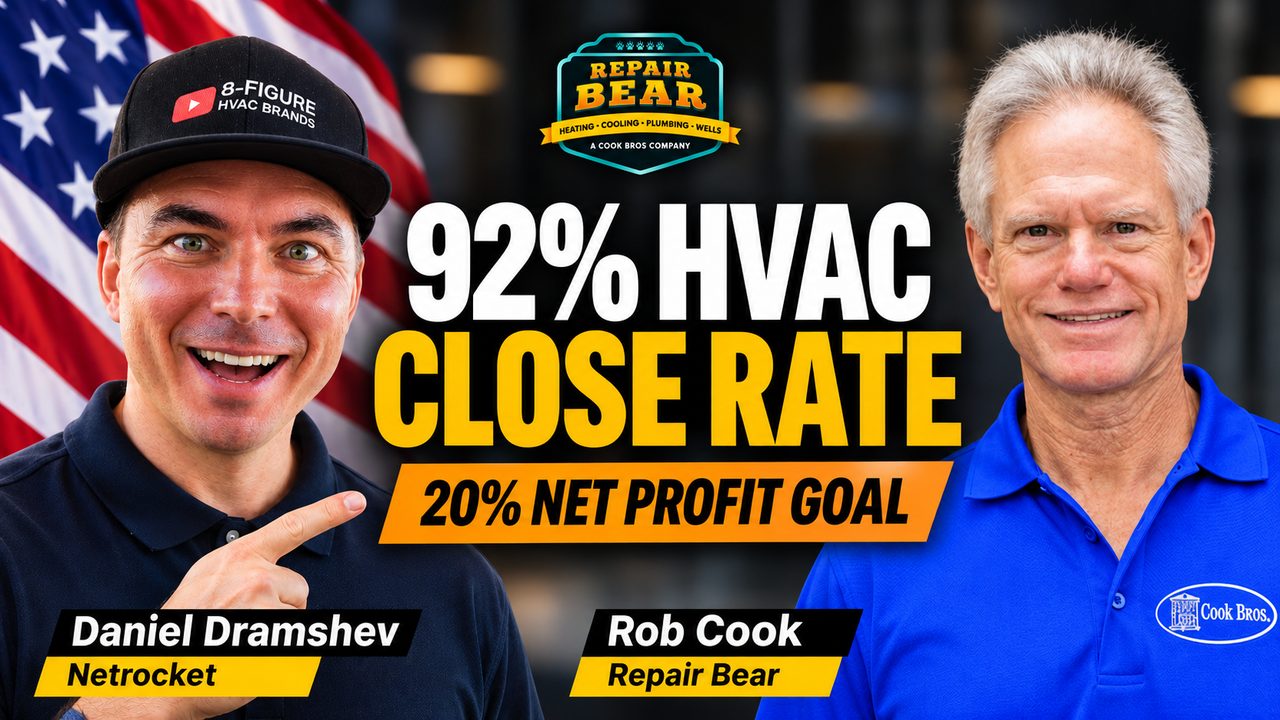
In Part 2 of our conversation with Rob Cook, owner of Repair Bear Heating and Cooling in Cody, Wyoming, Netrocket founder Daniel Dramshev digs into sales and profit. Rob explains how a $1,700-a-month radio budget and four wrapped vans made a new company look like the biggest player in town, how his team closes about 92% of in-home sales calls at full price, and how he prices every job for 20% net profit.
In Part 1, Rob shared how he came out of retirement, bought a competitor, doubled its prices, and did $1.2 million in HVAC in his first 15 months.
About the guest
| Name | Rob Cook |
| Company | Repair Bear Heating and Cooling |
| Location | Cody, Wyoming |
| Close rate | About 92% on in-home sales calls |
| Profit target | 20% net profit on every job |
From $13 an hour to $650,000 a year
Rob’s model for building a business that runs without him is Steve, who runs his remodeling company in Virginia. Steve started as a carpenter at about $13 an hour. Rob made him a working foreman, then gave him two jobs to manage, then three. When Rob got burned out, he spent two or three years training Steve to take over sales, pricing, contracts, and design.
Today, the Virginia company does $7 million to $10 million a year at about 18% net profit, and Rob expects $9 million to $10 million this year. Rob still owns 100% of it. Steve keeps the books, gets a salary of about $150,000, and earns a bonus of about 40% of the net profit. For the last five years, he has made $500,000 to $650,000 a year. He’s 55, and he owns about 18 rental properties.
“You got to focus on profit because that’s all that really matters.“
Rob plans the same path for Repair Bear. Instead of selling the company, he’ll transition out by sharing more of the net profit with Larry, the technician whose company he bought, and another team member, Will. They’ll get paid like owners without taking on the risk or needing the capital to buy the business.
A team that knows the numbers
Rob has six employees he’s investing in, and several of them make $45 an hour. He shares the numbers with the team. After every job, technicians fill out a job costing spreadsheet with hours, materials, and trips, and Rob walks them through the gross profit.
Rob and his wife are still the office overhead. She does the bookkeeping, and he handles the CRM, digital marketing, and the website. Fixing that is his challenge for the next 10 to 12 months. Even so, the company is booked out two months for installs.
$1,700 a month on radio
Rob spends about $1,700 a month on radio ads. He never thought anyone listened to the radio, but most of his customers are 55 to 75 years old, and they do. Within a few months, people at Walmart started calling him “the radio guy.” He wears his company shirt everywhere.
Repair Bear has four wrapped vehicles. In a small area, people see one almost every day, and some think the company has 50 vans. Many of Rob’s competitors are third-generation companies with four to six vans, low prices, and no website. Customers who moved to Wyoming from big cities are used to companies that look established.
“Ah, finally a real company I can call.“
Rob still answers the phone himself when he can. If he’s on another call or out of cell service, or the caller ID looks like spam, an AI answering service picks up. People are surprised to get a live person.
Rob estimates Repair Bear already has about 30% of its market. Distributors have told him Billings, Montana, a market of about 150,000 people, has competition just as weak. He says expanding there is only an idea for now. His advice for owners in small markets is not to assume they can’t make money there.
LSA at $35 a call and three Google Business Profiles
Repair Bear doesn’t run Google Ads or Facebook ads. Its only paid digital channel is Local Services Ads. Only three companies run LSAs in Cody, so a call costs Rob about $35, compared with a few hundred dollars in big markets. He gets about 10 to 15 calls a month, and over the last eight to 10 months, LSA has cost him about $450 a month in total. If you’re in a bigger market where LSA leads cost much more, see how Netrocket handles LSA management for HVAC contractors.
The company also comes up at the top of organic search. Rob has three Google Business Profiles: one for Cook Brothers, his plumbing and wells company, one for Repair Bear, and one for Better Comfort Solutions, the company he bought from Larry. They often hold several of the top spots on Google Maps. Learn more about Netrocket’s Google Maps SEO.
Pete Ramsey, whom Rob worked with for hundreds of hours on the brand, the van wraps, the mission statement, and the website, chose the name with him. Cody exists because of Yellowstone, and Yellowstone is synonymous with the grizzly bear. For more from Pete, see our episode on HVAC branding and positioning.
Rob cites a marketer who says 70% to 75% of a homeowner’s decision is made before they ever contact a company. The vans, the website, the Google presence, and the uniforms all do that work in advance.
Competitors that compete only on price
Rob sees competing proposals, and many companies still charge about $12,000 for a changeout, the same as they did years ago, even though their costs have doubled. He says they don’t project enough value to charge more, so price is the only way they can compete.
“They’re going into bankruptcy on the installment plan.“
He also points out that an HVAC company is a people business, both with customers and with employees. Repair Bear doesn’t manufacture anything, so the team is what makes it valuable.
A 92% close rate at full price
Larry now runs about three sales calls on his own for every one Rob goes on. When the team goes to a home, Rob says it closes about 92%, and that’s with full pricing. Repair Bear also works with four builders who pay full retail price, because they can’t find other trades they can count on.
“If we go to their house and talk to them, we’re closing nine out of 10.“
Here’s how a typical replacement sales call goes:
- The appointment is booked in the company’s CRM, and the homeowner gets an automatic confirmation
- On the day of the visit, the homeowner gets a text when the team is on the way and can track the van, like an Uber
- The team parks properly, never blocking the driveway
- Rob hands the homeowner three business cards, one to keep and two to pass on to friends
- The team spends anywhere from a minute to 25 minutes building rapport before talking about HVAC
- When the system is old, Rob asks Google out loud how long that type of furnace usually lasts, so the homeowner hears the answer from someone other than him
- He explains that, in his experience, 90% to 95% of HVAC equipment is oversized, and why bigger isn’t better
Then Rob scans the house with a LiDAR-equipped iPad and Conduit Tech software, which builds a 3D model and a Manual J load calculation. His area doesn’t require one, but Rob does it anyway. The scan takes 15 to 30 minutes and produces a 30-page report. Rob says it’s normally a $300 to $400 service, and Repair Bear does it for free. If a home has no Wi-Fi, he uses a Starlink in his van.
“I consider it malpractice to not do it.“
If the ductwork can’t support air conditioning, the team won’t install it, even if that means losing the job. While Rob scans, Larry walks the homeowner through system options. Then Rob gives a ballpark price based on a similar job they’ve done, for example about $21,000, and can show the paid invoice in the CRM.
Homeowners who have gotten other bids say other companies were there for five or 10 minutes before showing prices. Repair Bear has been there for an hour. Rob says that once homeowners trust the team as experts, they don’t compare on price.
“We’re on the same side of the table. We’re on your side.“
Usually, Repair Bear is the first company in the house, because Rob answers the phone and books the appointment right away. If someone wants to collect a stack of bids, Rob says Repair Bear probably isn’t the right fit, and that’s fine.
What’s next: a sales book and financing
Rob admits his team doesn’t have a printed sales book yet, and he plans to create one in the next three or four months. He prefers paper over an iPad, because he can hold it and look the homeowner in the face. It will include photos of the team’s work, so homeowners can see what a side-discharge heat pump or a wall-mounted condenser looks like, and possibly good, better, and best options.
Repair Bear offers financing through Synchrony, but only three or four jobs out of 100 use it. The sales book will show a monthly payment right under each price, so homeowners who want financing see it without anyone having to bring it up.
Rob is also turning technicians into “bird dogs.” When they find a system that needs replacing on a service or maintenance call, Rob or Larry comes out to take over the sale.
Pricing for 20% net profit
Rob uses net profit pricing, which he learned from Pete, not markup or gross margin pricing. His bidding spreadsheet starts with equipment and materials, then builds the customer price from there.
“I design and price everything we do for 20% net profit.“
On a $20,000 job, that’s $4,000 in net profit. A few of the details behind that number:
- Every job carries a 3% fee for card processing and financing costs, which Rob can remove as a cash discount
- Drive time counts, because a technician who’s driving half the day is only about 50% productive
- A technician paid $45 an hour, plus labor burden, means charging about $160 an hour before overhead and profit
- Rob’s overhead assumption is 21%, and more than half of that is salaries for him and his wife, even though they don’t draw them
Rob includes those salaries on purpose. If you leave out what your own work costs, your numbers are wrong, and a buyer will see it. He says many small owners think they’re making money on $45 an hour of labor, but after real costs, they’re making about $13 an hour.
Training is part of the cost too. Repair Bear charges $199 for a service call. When Rob brings a new technician along to learn, the visit costs him $200 to $300 more than it brings in. He tells the technician that, and if someone doesn’t appreciate it, they don’t get the next ride-along.
Sometimes the company beats its labor estimate, and Rob finds other work so the crew still gets a full week. He doesn’t send anyone home with less than a 40-hour paycheck.
Rob says Repair Bear is still in startup mode, but it has already done about 40 installs and $1.3 million to $1.4 million in HVAC in 15 months.
Subscribe on 8-Figure HVAC Brands Podcast
New episodes of the 8-Figure HVAC Brands Podcast come out every week, so subscribe on YouTube to catch the next one.