|
Getting your Trinity Audio player ready...
|
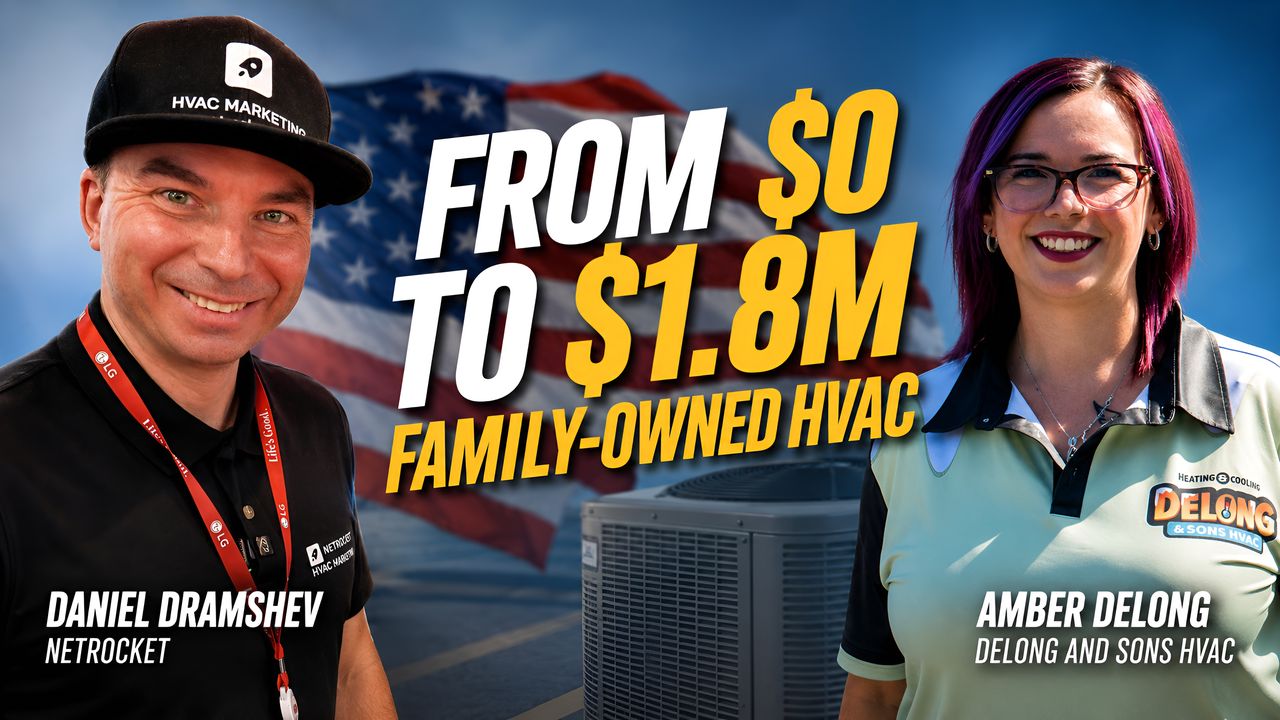
In this episode of the 8-Figure HVAC Brands Podcast, Netrocket founder Daniel Dramshev talks with Amber DeLong of DeLong & Sons HVAC in Pennsylvania. In five years, Amber and her husband Justin grew a side hustle into a family-owned company with 10 employees, six trucks, more than 400 Google reviews, and $1.8 million in revenue. She shares how they compete with private equity-owned companies, what helped them fix pricing, and which marketing channels actually worked.
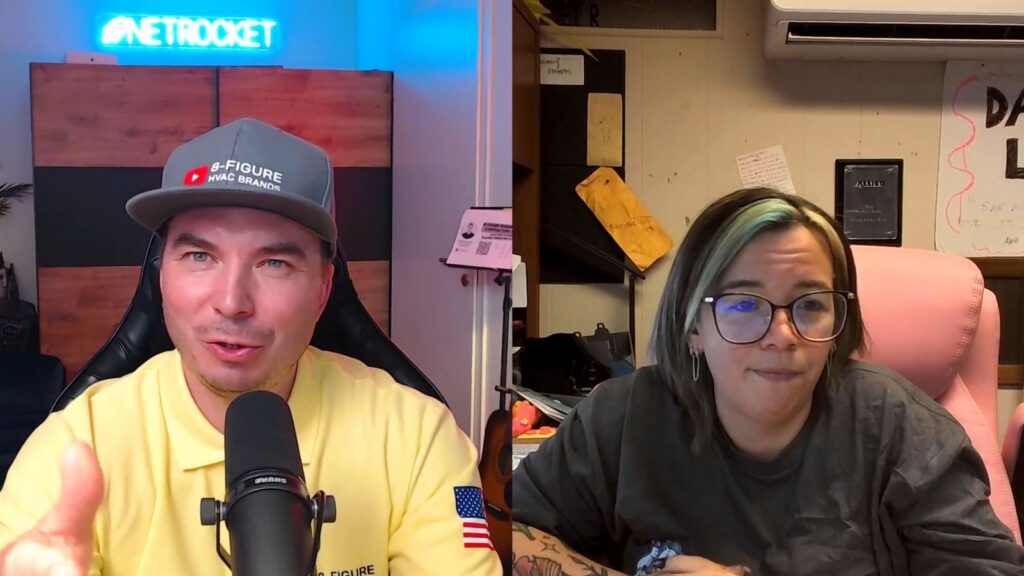
In Part 2, Amber opens her Housecall Pro account and shows the automations behind their calls, estimate follow-ups, and Google reviews.
About the guest
| Name | Amber DeLong |
| Company | DeLong & Sons HVAC |
| Location | Pennsylvania |
| Team | 10 employees, 6 trucks |
| Revenue | $1.8M in 2025 |
From a joke to a $1.8M company
Justin started the business about five years ago after working as a manager for two large private equity-owned HVAC companies, with all the headaches of the job but not the pay. The idea started as a joke at home, and the name came from their two sons.
For the first months, Justin ran calls after his day job, while Amber handled emails, paperwork, and payroll after full days in corporate America. They hired their first employee in 2022, and Amber joined the business full-time in January 2024. Today they run separate service and install departments and are starting to expand into plumbing.
Their revenue grew step by step: about $200,000 in the first partial year, around $500,000 in 2022, over $1 million in 2024, and $1.8 million in 2025.
Competing with private equity
DeLong & Sons competes with PE-owned companies that do three or four times their revenue, and with small one- and two-person shops. Their edge is a family brand: employees and customers should feel like family. Amber also enforces the same processes and checklists on every job, and the company partners with an extended warranty provider that covers refrigerant, which few competitors can offer.
Pricing and profitability
Amber is open that pricing and net profit have been their biggest struggle. PE companies spread overhead across many more employees, while small shops have almost no overhead and very low prices. DeLong & Sons now targets 15% to 25% net profit and is getting close to hitting that range consistently.
Her biggest recommendation for owners at 6% to 7% net profit is business coaching. A short course through her supply house gave her the basics, but the Housecall Pro coaching program gave her the tools to understand financials, loaded labor rates, and overhead by department.
“The two things that have helped us the most are business coaching and figuring out how to properly use AI.“
She uses Claude to analyze reports and financial documents, ChatGPT for writing emails and messages, and Gemini for marketing images. She has even built small add-on tools on top of her CRM.
First customers: word of mouth, Facebook, and LSA
The first customers came from word of mouth and Facebook, with family members sharing posts. Then Google Local Services Ads built about 45% of their early customer base. They later handed their Google Business Profile, website, SEO, and LSA to a marketing agency they got through a manufacturer dealer program, and lead quality improved.
Amber still uses local Facebook community groups: when someone asks about HVAC or plumbing, she tags the business page. It’s free and fits into time people already spend scrolling. Angi and Thumbtack, on the other hand, were a waste of money for them.
Rebranding that paid off
Their first logo had the usual sun and snowflake. After about two years, their supply house rep pushed them to stand out. They spent just under $10,000 on a full rebrand: a cartoon logo of the family, a brand guide, uniforms, social media assets, and a van wrap design.
“It’s hands down the best money I’ve ever spent in our business.“
After the rebrand, the phones started ringing. Many new customers say they saw the van on their street or at a neighbor’s house. A small billboard campaign didn’t pay off, but regular mail did: manufacturer direct mail campaigns, quarterly newsletters, and printed reminders for maintenance visits.
What they learned about SEO and LSA
Before finding the right agency, they spent thousands on SEO companies that didn’t move them up in Google. Amber’s advice is to vet agencies through other contractors and community groups, not just their reviews. If you’re looking for a partner, see how Netrocket approaches HVAC SEO.
With LSA, they typically pay $25 to $75 per lead, depending on whether it’s service or an install. Amber sets the weekly budget high and turns LSA on when the schedule gets light. She says LSA has worked better for them than Angi, Thumbtack, or Yelp, and recommends that contractors who tried it years ago give it another try. Learn more about LSA management for HVAC contractors.
Sales process and KPIs
Amber’s mom handles calls as their CSR. Leads from LSA and other sources go straight into the CRM, where the office schedules and dispatches them. Free estimates are only for full system replacements, and Justin presents good-better-best options on site.
Amber tracks KPIs for every department. For estimates, she tracks approved, declined, and pending jobs, extended warranties sold, financing, and whether notes and photos were uploaded for installers. Justin’s close rate is 50% to 65% month over month, without high-pressure sales.
Partnership and family goals
Amber and Justin complement each other: she runs processes and operations, and he handles the technical side and stays calm when things get stressful. Their goal is not a PE exit. They want to keep the business in the family, and their 15-year-old son is starting HVAC tech school.
Advice for owners under $1M
Amber’s advice for one-truck owners is to start with business coaching. If that’s not in the budget, find a mentor in the same trade, ideally one who uses the same software.
Subscribe on 8-Figure HVAC Brands Podcast
New episodes of the 8-Figure HVAC Brands Podcast come out every week, so subscribe on YouTube to catch the next one.