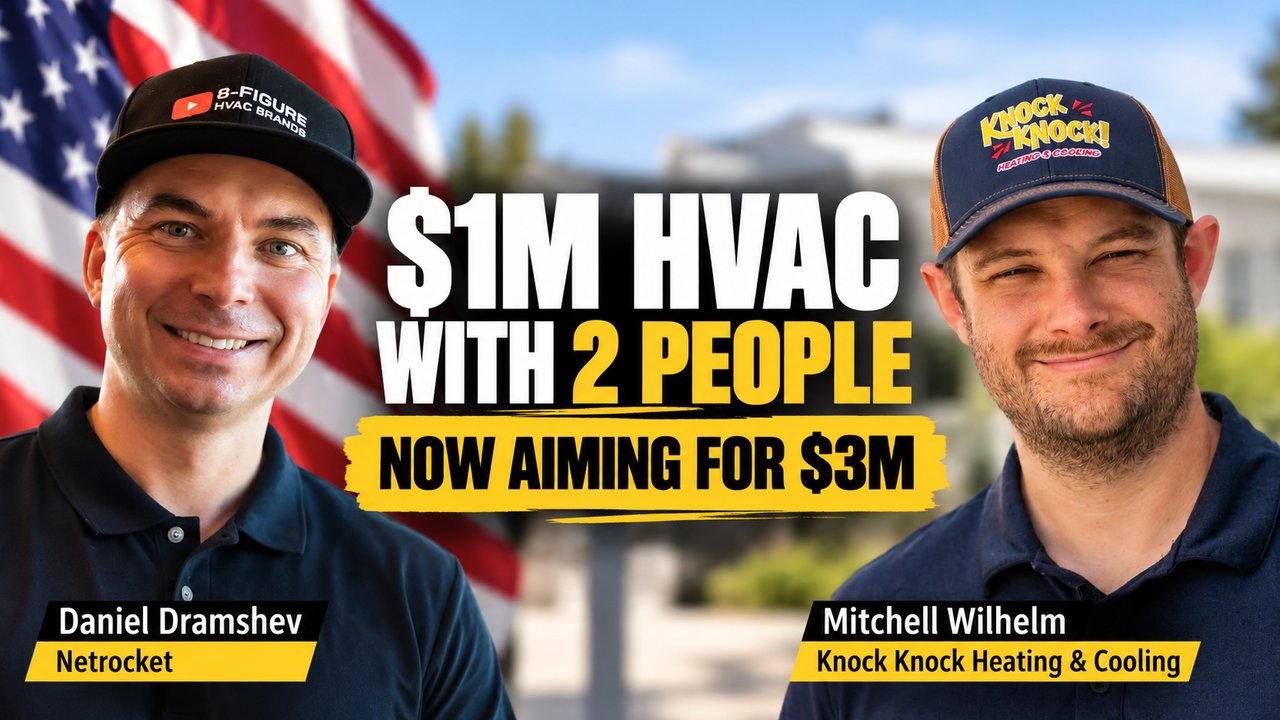
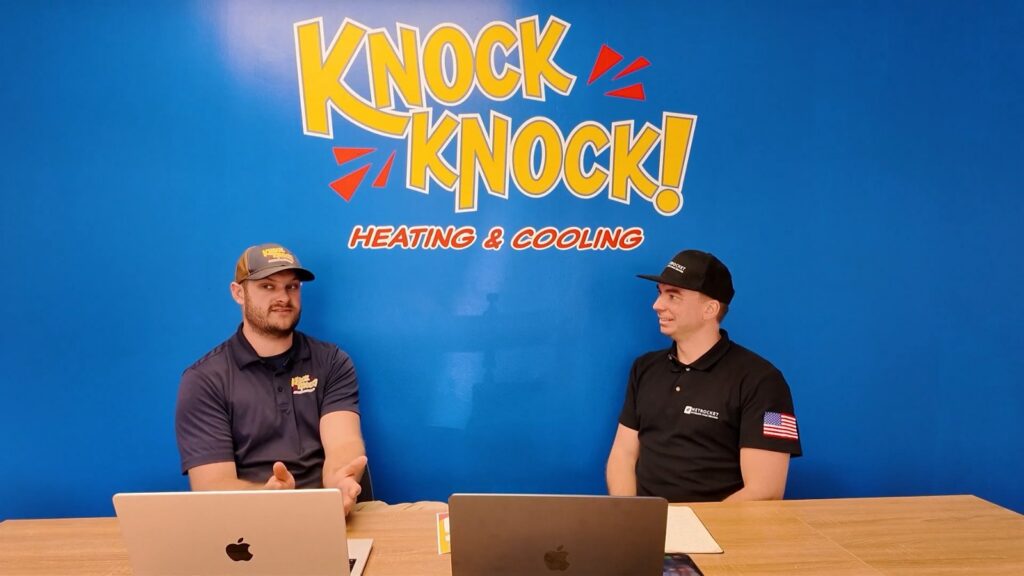
In this episode of the 8-Figure HVAC Brands Podcast, Netrocket founder Daniel Dramshev visits Mitchell Wilhelm, owner of Knock Knock Heating & Cooling in Cincinnati, Ohio. For most of the year, the company was Mitchell and one technician, and it’s on track to pass $1 million. Now Mitchell has a team of six and is planning for $3 million next year. He shares his real marketing numbers, why he got on ServiceTitan as a one-man shop, what a truck phone number actually brings in, and the $27,000 SEO mistake he made early on.
About the guest
| Name | Mitchell Wilhelm |
| Company | Knock Knock Heating & Cooling |
| Location | Cincinnati, Ohio |
| Founded | April 2023, branded as Knock Knock in spring 2024 |
| Revenue | About $500,000 in 2024, $690,000 in 2025, on track for $1.1 to $1.2 million this year |
| Team | Six people, including Mitchell |
A small shop with big plans
Knock Knock works out of a shop with an office, a meeting room, and a warehouse that’s almost bigger than the company needs right now. Mitchell’s 7-year-old son earns money there by cutting and stripping wires from old units. In the corner stands a Coke vending machine from his great-grandfather’s trucking shop near Chicago in the 1950s.
The company doesn’t stock much equipment. There are four supply houses within 10 minutes, so the team usually picks up equipment the day of the install or the day before. Mitchell wants to offer customers a wide range of options, and he doesn’t want whatever is sitting in the shop to sway what the team recommends.
From a CRM desk job to HVAC
Mitchell has been in the trade for about nine years. In college, he had an internship at a software company, finding leads for salespeople in Salesforce. He liked his managers, but sitting at a desk all day drained him. He comes from a family of entrepreneurs, though no one in it had worked in the trades, and he always knew he wanted to own a business.
His dad suggested calling the HVAC company he used at home. That company trained its own technicians from scratch, so Mitchell didn’t go to trade school. He rode along in a truck and learned everything he could, both technical and sales. Later, he tried to move up into sales and management roles at other companies, but those openings depend on being in the right place at the right time.
Mitchell started his own company in April 2023. That year, he and his family moved back to Cincinnati from Texas when their daughter was 12 days old, and Mitchell worked out of an unbranded white truck.
“You got to hit the road and go. There’s money there. Just go grab it.“
He spent that year figuring out what kind of business he wanted to build. From the start, he wanted a company that could survive without him.
Branding: Knock Knock
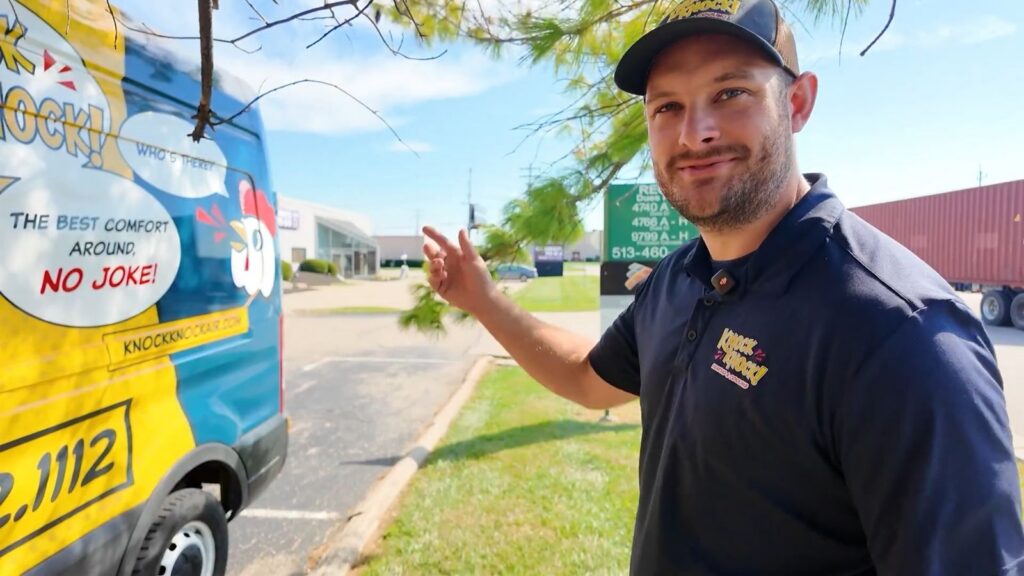
When Mitchell went looking for a website, the co-owner of a marketing company told him he needed a brand first. If he did it now, he wouldn’t regret it. If he waited, he’d have to change truck wraps and everything else later. He took the advice, and in spring 2024, the business became Knock Knock.
Mitchell didn’t want a brand that takes itself too seriously.
“Just because you’re professional doesn’t mean you can’t have fun.“
He has gone through two websites, and each cost about $6,000 to $9,000. The current one was built well, so the team only makes adjustments. Cincinnati has many established companies with strong brand recognition, and Mitchell doesn’t think treating customers right is enough to grow against them.
“I think we have to be memorable.“
The truck phone number that got two calls
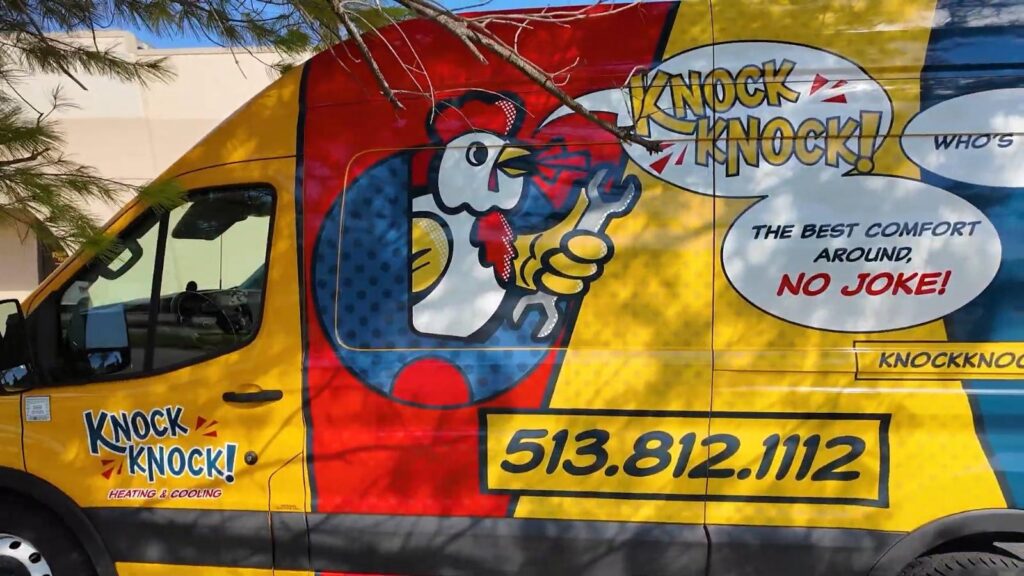
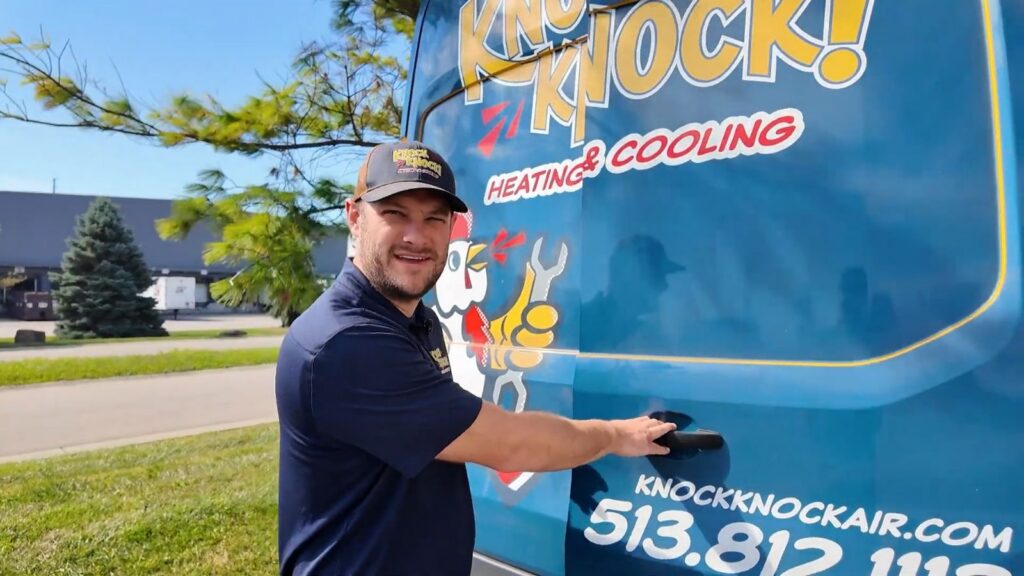
Knock Knock’s truck has been wrapped for at least a year, and the phone number on it is used nowhere else. In that time, it has gotten two calls. People who called about the truck, for example to say a tail light was out, dialed the number from the Google Business Profile instead. Mitchell thinks the truck brings in plenty of calls, but people search for the company rather than dialing the number. The new truck wrap won’t have a phone number or website on it.
Revenue so far
In 2024, the first year as Knock Knock, the company did roughly $500,000, all of it with Mitchell alone. In 2025, it did $690,000. When the recording was made, Knock Knock was a little under $900,000 for the year. Mitchell expects to pass $1 million and finish at about $1.1 to $1.2 million.
Today, there are six people on the team:
- Mitchell
- Two technicians
- A lead installer and a helper
- A remote CSR who handles phones, scheduling, and dispatch
Most of that team is new. From January to June, it was Mitchell and one technician who did service, installs, and sales. The second technician started in early June, and the install crew and CSR joined last month. A local fractional operations person is starting soon to help build systems and processes.
The first hire lesson
Mitchell hired his first employee in early June 2025 as an installer, while he ran service calls and sold systems himself. Revenue dropped month after month, down to about $40,000 in August. He was so busy in the field that he wasn’t making outbound calls or scheduling maintenance, even though there were hundreds of customers in the database.
So he trained the installer to run service calls and sell equipment, and Mitchell spent more time in the office, where he could at least book calls from a computer. In November, the company did $80,000 to $90,000, and in December, about $100,000. This year, more marketing spend and outbound calls for tune-ups in April led to a much better summer.
All in on Google
Knock Knock doesn’t do much with lead aggregators. Mitchell puts almost all of his marketing budget into Google, because he can track it well and he’s learned that spreading a small budget around doesn’t work for him. When he spends more, he gets more leads and makes more. Ad spend is a little under $10,000 a month, mostly on Google Ads, plus Local Services Ads and a little Meta. See how Netrocket handles HVAC PPC.
The numbers he shared:
- Average cost per paying customer this year: a little over $600
- Average ticket on all Google leads this year: $4,700
- In August: $9,000 in spend, 21 paying customers, and $432 per paying customer
Mitchell says he sleeps fine paying $600 per customer with a $4,700 average ticket. But if the average ticket dropped to $2,000, that cost would be a problem.
Local Services Ads don’t do well for him. One reason is that Knock Knock doesn’t run LSAs on weekends, and Mitchell believes that hurts the company in the algorithm during the week. If your LSAs aren’t pulling their weight, see how Netrocket handles LSA management for HVAC contractors.
Knock Knock has 146 Google reviews, while some competitors in Cincinnati have thousands. Even so, when Daniel searched, it showed up second in the organic Google Maps results.
“I want to be better than them.“
Mitchell has worked for and competed against the big companies in his market, so he knows how hard it is to catch up. He doesn’t wish them to fail, but he wants to exceed what they’ve done.
ServiceTitan for a one-man shop
Mitchell got on ServiceTitan in fall 2024, when it was just him. He wanted to track data and build out his price book. He told ServiceTitan he had three technicians, which just meant he paid more. For about a year, he felt it was a mistake. He had to learn the dispatch board, the price book, and the accounting side on his own.
Today, he pays about $1,200 a month for four managed techs, and about $3,000 a month in total with Marketing Pro and Scheduling Pro. On Workiz, he paid about $700. New hires often already know ServiceTitan, but the biggest benefit for Mitchell is networking. Owners of larger companies can show him exactly how they’ve set up their price books and technician forms, and he can copy that into his own system.
“Do I overpay for a CRM for a million dollar company? 100%.“
He says it’s worth it, because when people help him, he wants to make that help easy for them.
“I want people to enjoy helping me be better.“
Booking rate and the AI assistant
Until the CSR started, Mitchell answered most calls himself. In a meeting, he had to decide whether to interrupt the conversation or miss a call he had paid a lot of money for. Across all incoming calls, Knock Knock books about 21% this year. The industry benchmark he tracks is about 40%. Mitchell says spam calls make up a bigger share of calls for a small company, but the gap is too big to ignore. On qualified calls, the CSR books about 85%.
Mitchell set up an AI assistant before he hired the CSR. It’s connected to ServiceTitan, answers after hours and when the team misses a call, and books appointments during normal business hours. Mitchell hasn’t let it book after-hours calls yet.
Selling without scripts
Mitchell has written his own tech selling manual. It includes suggested ways to say things, but it’s built around concepts instead of scripts, so technicians can show their personality. He compares it to a server at a restaurant. Some rattle off the specials like they’ve said them 20 times. Others talk about a dish so naturally that you want it even if you don’t usually eat it.
Technicians build repair options in ServiceTitan on an iPad, and they can also use paper presentation books if they prefer.
How to get from $1 million to $3 million
Mitchell believes the current team can do $3 million next year, maybe with one or two more people. He’s already working on the 2027 budget. To get there, he estimates ad spend has to reach about $20,000 to $27,000 a month, so he plans to grow spend 20% to 40% month over month instead of starting January at $8,000 to $10,000.
He sees several growth opportunities that don’t need a bigger ad budget:
- Outbound calls to the 600 customers in the database, for example offering a free tune-up
- Running after hours and on weekends
- Yard signs, door hangers, mailers, and email marketing
- Selling more maintenance memberships
Today, Knock Knock’s only offline marketing is furnace stickers, T-shirts, and business cards. Mitchell admits he’s picky about design and won’t buy a yard sign unless it looks right.
The company has about 80 maintenance members. On non-member calls, technicians convert only about 12.5% of customers into members, and Mitchell thinks it should be closer to 40% or 50%. In spring, outbound calls to maintenance customers helped a lot. Daniel calls the slow months winning season, a term from our episode with Treasure Boston of Cline’s Heating and Air.
The $27,000 SEO mistake
Early on, Mitchell spent $3,000 a month on SEO for his website and Google Business Profile. The business address was his house, and the company had about 17 reviews.
“I can verify that through seven months I got zero phone calls from organic and I spent $27,000.“
He says the investment wasn’t the problem, but the timing was. Until the business had a real address, SEO hardly did anything. If you’re working on your Google Maps rankings, see how Netrocket handles Google Maps SEO.
The bigger challenge, he says, is consistency. In slow seasons, a good week followed by two bad weeks can mean three weeks without making money. Sometimes the goal is just to break even on a week, so a win stays a win.
“Every day is kind of a grind and so we just kind of stick with it and keep going.“
Subscribe on 8-Figure HVAC Brands Podcast
New episodes of the 8-Figure HVAC Brands Podcast come out every week, so subscribe on YouTube to catch the next one.