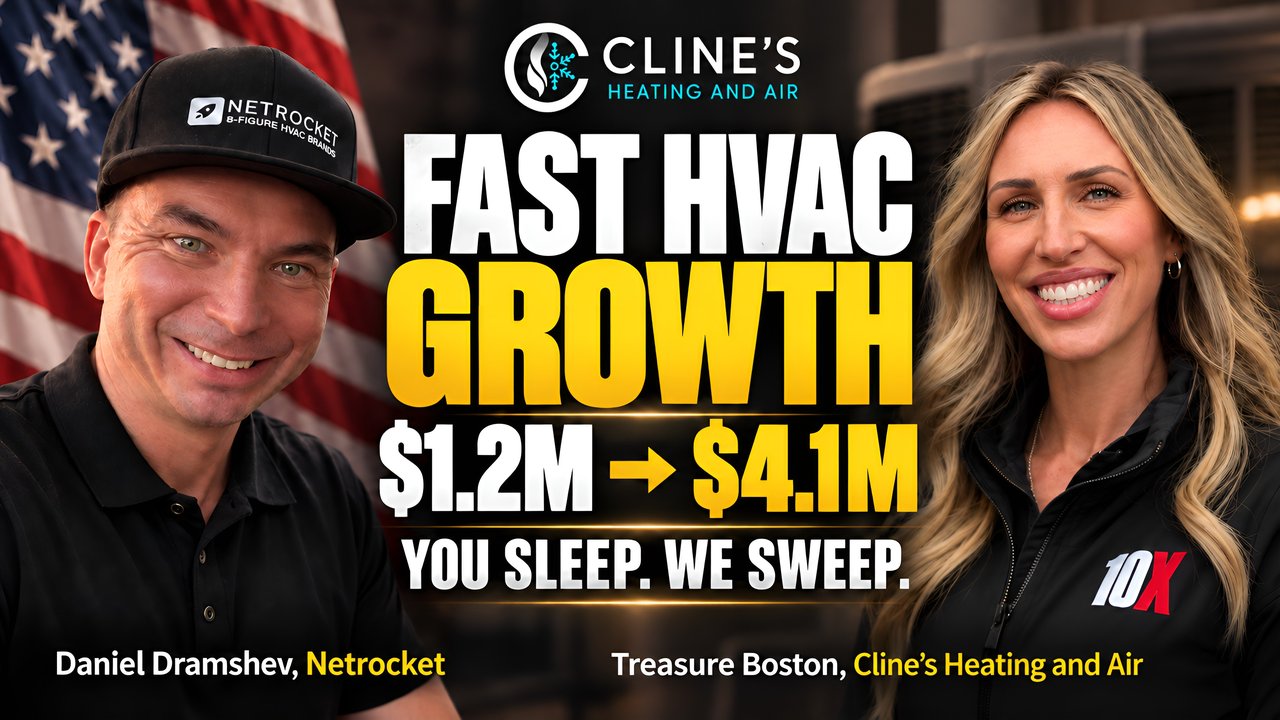
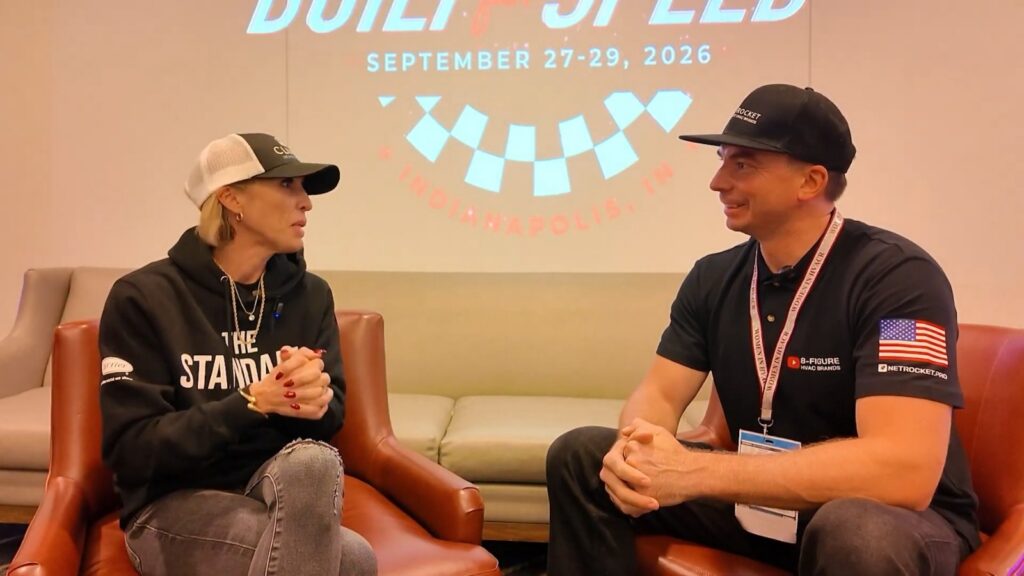
In this episode of the 8-Figure HVAC Brands Podcast, recorded at the Women in HVAC event in Indianapolis, Netrocket founder Daniel Dramshev talks with Treasure Boston, co-owner of Cline’s Heating and Air in Spokane Valley, Washington. Before she and her husband bought the company in 2024, its best year was $1.2 million. In 2025, it did about $4.1 million. Treasure explains how they rebuilt an old-school company, how they hire, why they don’t believe in a slow season, and how they plan to compete with private equity.
About the guest
| Name | Treasure Boston |
| Company | Cline’s Heating and Air |
| Location | Spokane Valley, Washington |
| Acquired | May 2024 |
| Revenue | $2 million in 2024, about $4.1 million in 2025 |
| Target | $8.5 million in 2026 |
From house cleaning to HVAC
Treasure grew up in the trades. Her mother, her aunts, and even her great-grandmother cleaned houses. Treasure learned the work from her mom, started her own cleaning company, and exited it last year.
Her husband comes from HVAC. His father and uncle founded Comfort Systems of Montana in Bozeman in 1999, and he took over the company from his father. After they married, Treasure got involved with Comfort Systems, and the couple went on to buy Cline’s Heating and Air. They also own a demolition company in Bozeman. To Treasure, business is business: you train teams and scale the same way, just with a different product.
Their territory manager calls Cline’s the fastest-growing HVAC company in the region.
From $1.2 million to a $6.5 million year
Cline’s was founded in 1988 and was still run by the same family when Treasure and her husband bought it. Its best year had been $1.2 million. They closed at the end of May 2024 and finished that year at $2 million. In 2025, they did about $4.1 million. The team’s target for 2026 is $8.5 million. They’ll fall a little short, but they’re on track for about $6.5 million.
The company they bought had no CRM, no real website, and no Google Business Profile. Invoices were three-part paper forms. One copy went to the customer, one went to an owner for data entry in QuickBooks, and one went into a filing cabinet. The customer database was the filing cabinet.
For the first three months, they changed nothing. They watched, got to know the team, and learned what winning looked like to each person. Then they let go of the people who didn’t want to win and hired people who did. They moved to ServiceTitan, built a real website, and set up a Google Business Profile. If you’re building your local presence from scratch, see how Netrocket handles Google Maps SEO.
Treasure says they could have grown faster, but without systems, they would have made promises to customers they couldn’t keep. They didn’t have enough installers they trusted, and fast growth would have hurt their reputation.
“We really had to slow down to go fast.“
Two owners, two lanes
Treasure’s husband is a master installer and, in her words, one of the best system designers in the country. He oversees the field team and makes sure installs deliver what the comfort advisors and technicians promise. Treasure oversees recruiting, sales, and marketing. Both of them build the culture.
For another husband-and-wife team’s take on culture and hiring, read our episode with Janal Reid of Serveway.
A three-part interview process
Everyone who joins Cline’s goes through three interviews, even people the owners already know:
- Cultural alignment: a check that both sides are a good fit, with the company’s core values laid out up front
- Technical: office candidates spend a day answering phones, and field candidates go out in the field to show what they can do
- Core values: candidates give a presentation on what each core value means in their own life
The leadership team decides together after the third interview. If they still aren’t sure, they bring the person in for a fourth. Treasure says many people in the trades aren’t good resume writers, while some office candidates pad theirs. Testing them in the real job shows the difference. Sometimes candidates don’t even show up for that day.
Skills matter, but attitude matters more. Cline’s will let go of a skilled person who drains the team’s energy.
“We hire for attitude, train for skills.“
Marketing channels by season
Cline’s used to be a commercial service company. It did residential work only as a favor for commercial customers. Today, the business is about 50% commercial and 50% residential. About 90% of commercial customers have quarterly maintenance agreements, so they call Cline’s when something fails. Residential customers are different, so marketing has to make sure homeowners can find the company when they need it.
In the busy season, Google Ads and Local Services Ads lead. Treasure says LSA used to be a huge source of leads, but that has changed, and in spring and fall, the leads get expensive and rare. If you want more from your LSA budget, see how Netrocket handles LSA management for HVAC contractors.
Meta ads run all year. Treasure recently fired her Meta ads agency because it kept using stock images instead of real photos of her team, even after she gave it the brand guide. She would rather pause a campaign than run ads that aren’t authentic.
Cline’s also invests in SEO and in showing up in AI answers. The team makes sure the company comes up in Reddit threads and recommendations, and it joins every local Facebook group it can find. They introduce themselves and take part in conversations, without spamming. See how Netrocket approaches AI SEO for contractors.
Offline, Cline’s goes to fairs and community events and uses door hangers. Every marketing channel has its own phone number tracked in ServiceTitan, so the team knows which campaigns work and turns off the ones that don’t.
There’s no slow season, only winning season
Treasure doesn’t like the term shoulder season. She calls it winning season. Laying people off isn’t an option for her, so when demand calls drop, the team gets proactive.
“That’s when we take your market share from you.“
Her short version: “You sleep and we sweep.”
Last winter was unusually warm, so the team had to get proactive. CSRs average 80 outbound calls a day, setting appointments and scheduling maintenance. The team calls the company’s customer list, which goes back to 1988, and phone lists it has bought.
Preparation starts in summer. Even when phones are ringing off the hook, the team keeps selling maintenance plans so it has work when demand calls slow down.
Daniel later brought up winning season in our episode with Mitchell Wilhelm of Knock Knock Heating & Cooling, a small Cincinnati shop on its way from $1 million to $3 million.
Buying a closed company’s phone number
Right before Christmas, technicians from a local company that had just closed its doors came to Cline’s looking for work. Treasure’s husband reached out to the owner. Cline’s didn’t want the company’s name, but it wanted the good team members, the customer list, the website, and the phone number on stickers on furnaces all over the region.
The deal gave the former owner 10% of the revenue from that database and phone line. He breached the contract, so the deal ended quickly, but Cline’s kept the book of business. The old phone line still rings, and it brought in a couple of equipment replacements this year from homeowners who called the number on their furnace. That’s also how Cline’s got its residential side going.
“Opportunity doesn’t wait for preparation.“
Treasure sees more of these chances coming. Many older owners are ready to retire, and some don’t want to sell to private equity. If they don’t know their options, they may just close.
From the first call to the close
Cline’s CSRs book about 84% to 85% of calls. An AI agent answers after hours and on weekends, books appointments, and transfers callers to a call center if needed. Treasure says the booking rate is off the charts compared with the old after-hours call center, which sometimes told customers the company didn’t take after-hours calls.
Comfort advisors still take calls that come in at 7 or 8 p.m.
“My team doesn’t really sleep.“
Sales is the weak link right now. Close rates aren’t where Treasure wants them to be. Technicians find opportunities and pass them to comfort advisors, and some technicians close the sale themselves. One of them, known as Revenue Ray, has higher profit margins than the comfort advisors.
Treasure has noticed that technicians with a higher average ticket also close better. They ask the uncomfortable questions and get curious about what the homeowner needs. To learn more about what works, the team just got Fieldly bracelets. The technicians wear them on calls, and the team will run the conversations through AI to find what works. Customers are told the call is recorded, and they’ll get the transcript with their report. Treasure plans to wear one herself, because she wants coaching too.
Everyone at Cline’s gets a commission on leads they generate. One weekend, the bookkeeper’s husband and kids went out putting flyers on houses, including Treasure’s.
20 to 30 Google reviews a month
Cline’s had no Google Business Profile until two years ago. Now it averages 20 to 30 Google reviews a month, and the team responds to every one.
Technicians carry key cards on lanyards and ask customers to scan them for a review right after the visit. ServiceTitan follows up with an automatic text and email. Every Friday, the company pays $20 for each review that mentions a team member by name. If a review names two people, they split it.
Branding, standards, and clean vans
Treasure and her husband rebranded the company after the purchase. She says branding matters for the team as much as for customers, because people need to be proud of what they wear.
Cline’s doesn’t have rules. It has standards. The team wears black, the guys shave and cut their hair, and van checks happen every Friday.
“Rules are meant to be broken. We have standards and standards are meant to be lived to.“
The vans work as billboards, but Treasure doesn’t expect anyone to call the number on them. People say “Hey Siri, call Cline’s Heating and Air” or search for the name on Google. So the goal of the branding is to be memorable.
Goals the team sets together
Cline’s starts with an annual revenue goal and breaks it down by month, week, and day, all the way to outbound calls. The whole team set the 2026 target. The owners first suggested $8 million, but the team said it wasn’t high enough and chose $8.5 million.
Transparency is one of the company’s core values. The team sees the numbers, so it can celebrate wins and work together when profit margins are low or targets are missed. There’s a bell in the office for every closed deal, and the team celebrates personal goals too. Pay and roles are based on what each person contributes, not on tenure.
“Winning is a team sport.“
The law of the lid
Comfort Systems of Montana is a $10 million company, and Treasure expects it to do $10.5 to $11 million this year. Once you’ve built a company once, she says, you know the hurdles at each break point. But what got them to $10 million won’t take them to $20 million, so they take advice from mentors who have built the businesses they want to build.
She points to the first chapter of John Maxwell’s book The 21 Irrefutable Laws of Leadership, the law of the lid. An owner’s leadership skills, belief, and operational effectiveness cap the whole organization. If you don’t invest in personal development, you won’t get very far.
Treasure says the first million is the hardest part, because with two or three technicians, one sick call can wreck a busy day. Until about $3 million, it’s tough, and it never stops being tough.
“Different level, different devil.“
Profit, pricing, and private equity
Cline’s isn’t the cheapest company in its market. Its service coordinator calls it the Gucci of HVAC.
“Price is only an issue in the absence of value.“
This year has been expensive. The company moved out of a rented building into one it built, and the owners don’t take any money out personally. Everything goes back into growth. Treasure says EBITDA should never be below 12%, and a healthy number is 20% to 25%. Comfort advisors look at gross profit, and their deals need to be between 40% and 55%. She also warns owners not to copy anyone else’s pricing, because pricing depends on your own overhead and numbers.
Treasure believes private equity has put profits over people in her area. Technicians from one acquired company came to Cline’s after it moved them to commission-only pay, which she says pressures techs to find problems that aren’t there. Her plan for the next six to eight years is to partner with locally owned companies in her market that are stuck at the same number every year. They keep their names, and Cline’s helps with culture, recruiting, and marketing, then builds an exit plan with them.
Treasure and her husband are building for an exit, and they’re also bringing two products to market under a separate company. One is a patent-pending fan that runs on the airflow in the duct system, with no electricity.
Subscribe on 8-Figure HVAC Brands Podcast
New episodes of the 8-Figure HVAC Brands Podcast come out every week, so subscribe on YouTube to catch the next one.