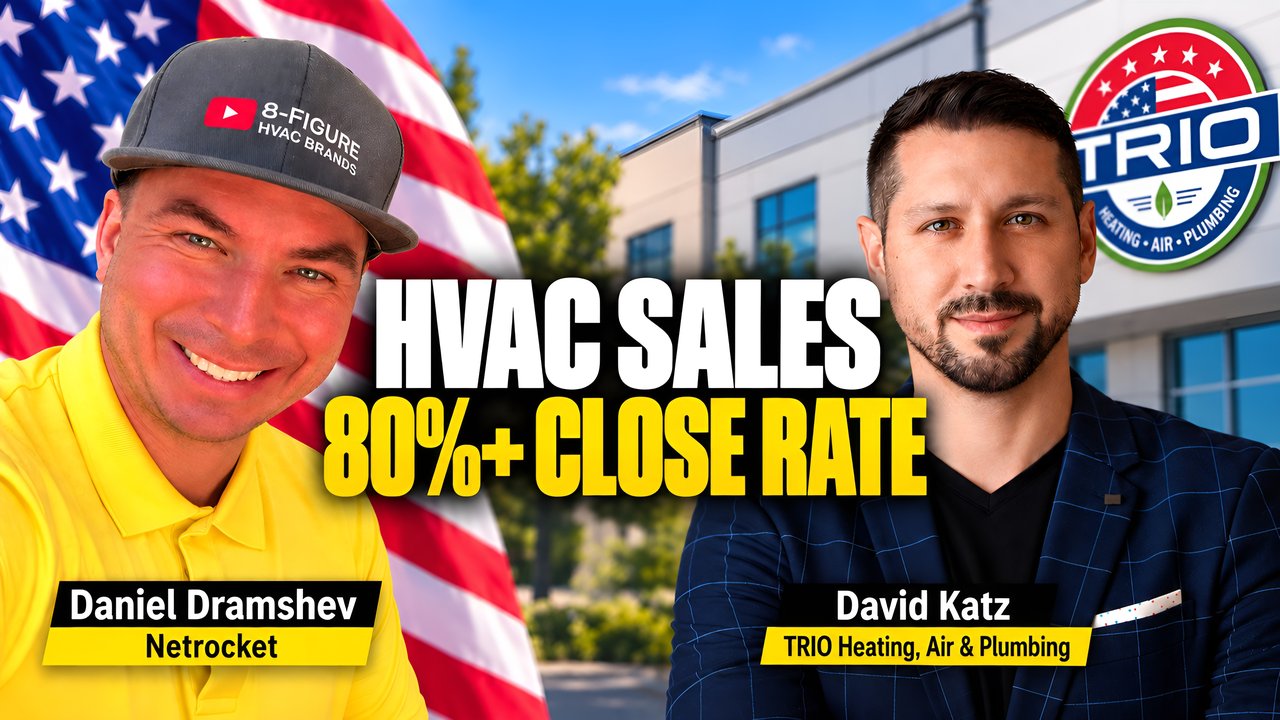
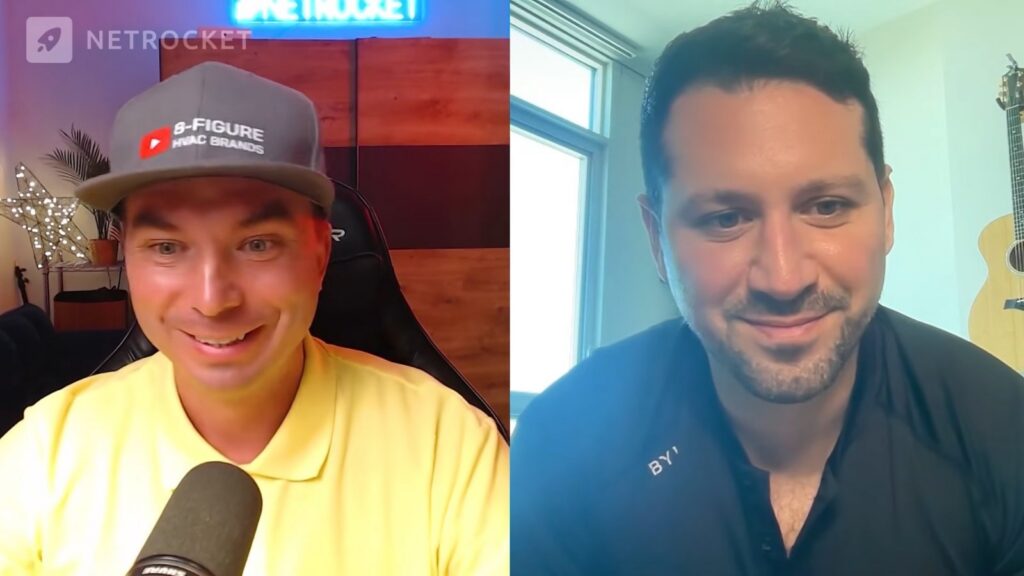
In Part 2 of our conversation with David Katz, co-founder and CEO of TRIO Heating, Air & Plumbing in San Jose, Netrocket founder Daniel Dramshev digs into sales. David explains why he prefers the technician-to-sales model, how his team reaches a close rate of 80% and higher on the best leads, why speed matters so much, and how financing grew to about 25% of TRIO’s revenue.
In Part 1, David shared how he went from $600 and a van to an eight-figure company, how much to spend on marketing, and how to plan a marketing budget backward from revenue goals.
About the guest
| Name | David Katz |
| Company | TRIO Heating, Air & Plumbing |
| Location | San Jose, California |
| Target | $50 million by the end of 2028 |
Two sales models that don’t mix
David sees two ways HVAC companies sell replacements today. The largest companies in the country use the technician-to-sales model. They want about 95% of incoming calls to be service calls for broken systems or tune-ups. The technician builds a relationship with the homeowner and turns the lead over to a salesperson.
Over the past few years, some companies have also reached $60 to $80 million doing replacements only. They run Instagram, Facebook, or TikTok ads with a clear offer, like 12-month financing with no interest or payments as low as $79 a month. Homeowners who call already know the price, so these companies may not even need a salesperson. Not sure which approach fits your company? Learn more about digital marketing consulting for HVAC companies.
David prefers the traditional model, and he says you can’t run both in one company. Replacement-only ads only work if your price is very competitive. If your salesperson quotes $18,000 for a heat pump system and the same homeowner then sees your $79-a-month ad online, you’ve undercut your own salesperson. And if two customers pay very different prices for the same job, that’s not fair to your customers.
How TRIO gets to be the only company in the house
There are about 600 registered HVAC companies in San Jose alone, and David estimates that 90% to 95% of them are two- or three-person operations. Still, TRIO is usually the only company in the house.
Homeowners may call three or four companies, but most quality companies charge a dispatch fee. TRIO charges $88 or $99 for the visit and waives it if the customer moves forward with the work. Few homeowners will pay five companies to diagnose the same problem, so they choose based on reviews, the website, and the phone call.
David wants 60% to 70% of those customers to do something with TRIO, whether that’s a repair, a maintenance plan, or a replacement quote.
The second pair of eyes policy
Technicians turn the call over to a salesperson in three cases:
- The unit is over 10 years old
- The repair is a major one or costs more than a set amount
- There’s a safety issue
The homeowner still gets both repair and replacement options. But once a technician suggests a replacement, David says the homeowner is now on the market for a new system. The goal is to take them off the market right away. Otherwise, a premium company risks losing the job to the cheapest bid. TRIO’s average ticket is about $24,000, while some competitors sell the same equipment for $12,000. David says his team often replaces 5- or 6-year-old systems that someone paid $12,000 for.
Guarantees, options, and financing
TRIO’s salespeople offer guarantees that help homeowners trust the process. For example, there are no change orders, and if the system fails, TRIO will fix it within 24 hours. They also present three or four options instead of one, because a single option is an ultimatum.
“You want them to choose between you and you, not between you and somebody else.“
Financing has grown fast at TRIO. Two years ago, it financed $600,000 of its revenue, and the year before that, less than $100,000. This past year, it financed $3 million, about 25% of revenue. David’s goal is 60%. When TRIO gets there, he’ll know the sales team has the right systems and processes in place.
The cost of financing is built into the price book, and so is the cost of credit card fees. The price stays the same no matter how the customer pays.
“Let them enjoy the process.“
The technician sets up the sale
David says 80% of a salesperson’s success in this model depends on the technician. The technician’s job is to build a relationship and reduce sales resistance. Even the best salesperson will struggle if the technician didn’t set up the call well.
TRIO’s salespeople should always be on an appointment. If no technician has set a lead for them yet, they do what David calls a “body check” and go into a home with a technician from the start. The homeowner gets two experts for the price of one, and the salesperson gets to see how the technician runs the first half of the call. David says one ride-along tells you more than looking at someone’s numbers from the office.
Speed decides the close rate
Ideally, the salesperson arrives within 20 to 30 minutes. Otherwise, homeowners start asking ChatGPT how much a new system should cost and who they should hire, and they often find wrong information.
David’s close rates by situation:
- Same day, technician and salesperson in the house together, and the technician already sold a maintenance plan: 80% and above
- Salesperson arrives 2 hours later, not together, and no maintenance plan: 50% to 60%
- Next day: 30% to 40%
- Two or three days later: 15% to 20%
“Speed is extremely important.“
Sales benchmarks at TRIO
For marketed calls, where a homeowner calls in about a new system and no technician has been to the house, David expects a salesperson to close 20% to 25% or more, with an average ticket of at least $15,000. These calls are harder, because a premium company is often competing with handymen and the cheapest contractors.
For technician-generated leads, the minimum is 40%.
“It is not the target. It is the absolute minimum that we would be willing to accept.“
If someone falls below 40%, something is wrong, either with the technician or the salesperson. One of TRIO’s salespeople consistently closes 75% of technician-generated leads.
Not selling, and sharing everything
TRIO gets three to five offers a week from buyers, but David isn’t looking to sell right now. His personal goal is to prove TRIO can become one of the largest HVAC and plumbing companies in the country without a corporate feel. He wants it to be known for paying employees the most, for quality, and for incredible customer service.
He’s also an open book. When a visitor on a shop tour tried to take a photo of a document on the wall, David had his team print every document for them, including pay plans, bonus plans, targets, and KPIs.
“If my competitor is going to get better, it’s going to force me to get better.“
He isn’t worried about giving away the playbook, because having the steps doesn’t mean you can follow them.
“Implementation is the hardest part.“
David learned much of what he knows by going on shop tours, asking questions, and building relationships with other owners, including Tom Howard, who was also a guest on the podcast. TRIO now hosts shop tours of its own in San Jose.
Is a trademark worth it?
David says a trademark is good for peace of mind, but it isn’t a must. From litigation he has seen in the industry, a company that can prove it used a unique brand first often wins even against someone who registered the trademark later. A generic brand with a house, a snowflake, and a flame is much harder to defend. Even if you win, a dispute costs time and money, so it’s better to avoid one.
Subscribe on 8-Figure HVAC Brands Podcast
New episodes of the 8-Figure HVAC Brands Podcast come out every week, so subscribe on YouTube to catch the next one.